

Why is it Important to Assess an Athlete’s Fitness and the Metabolic Demands of their Sport?
Verifying the individual’s starting level is paramount to designing the optimal program. This is also true for sports. Before the start of any season, coaches run a series of basic assessments specific to their sport in order to evaluate each player for talent as well as their metabolic efficiency (Note: for all those who ever participated in any sport, these were called “try-outs” testing your athletic ability for this sport!).
Remember, each sport’s basic testing procedures are not only specific to the fundamental movement patterns of the respective sport but also the sport’s primary energy system. Once the coach chooses the team, the ‘conditioning’ program ensues. Depending on the primary energy system of the sport, the bulk of the conditioning program will focus on developing the activity’s primary energy system. This is also where coaches can determine and establish individual conditioning programs for not only position-specific but individual-specific training.
Proper training intensity (along with adequate rest) is essential for the proper physiological adaptations (results). It should also be clear that the needed physiological adaptations for athletes are specific to their sport. So, the training intensity must be correlated with the type of strength and energy systems demanded by the sport.
To assess the needs of an athlete, the trainer/coach has to evaluate the individual (their current capabilities and limitations) and the needs of the specific sport and position. It’s not different from assessing a health and fitness client, except that the goals are now based on performance needs. Performance goals are much more specific than general goals (i.e., “lose weight,” “tone up,” “get big”).
Assessing the Athlete
Assessing an athlete is not the same as assessing a general fitness client. When evaluating a client, the fitness professional will assess the fitness components related to health and fitness. These Health-Related Fitness (HRF) components of fitness are related to performing activities of daily living (ADL) with vigor and are associated with a low risk of premature development of hypokinetic disease (disease from physical inactivity). When assessing an athlete, however, the fitness professional will also need to include Skill-Related Components of Fitness (SRF) which are sport-specific.
But think about it – do all athletes need the same levels of cardiovascular endurance? Of course not. The key to proper assessments of athletes is an accurate metabolic needs analysis.
Metabolic Needs Analysis for Athletes
Research and applied science have clearly shown each sport has specific needs, mainly referring to metabolic conditioning when training anaerobic athletes. The days of all athletes needing a firm aerobic base of conditioning are long gone. However, designing the right general physical preparation plan for developing a foundation of metabolic conditioning before moving to a sport-specific training program will enhance an athlete’s performance while decreasing the risk of injury.
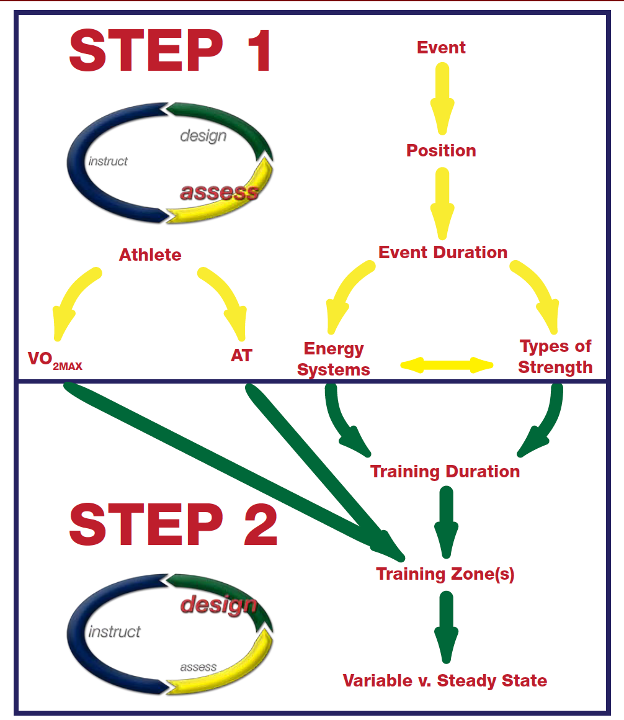
Different sports (as well as different positions within a sport) have different metabolic demands. A fitness professional’s job is to analyze an athlete’s metabolic needs (phosphagen, anaerobic glycolysis or aerobic metabolism). Certain events will focus primarily on one energy system (ex: a marathon runner would mainly concentrate on aerobic metabolism for energy). Other events will combine all three systems (ex: ice hockey). The fitness professional/coach must determine the predominant energy system(s) for the athlete’s sport and position.
Why is this important? Athletes must be careful to develop appropriate energy systems and not overtrain an inappropriate energy system. Overdevelopment can cause a substantial decrease in performance (particularly in high-power output-based sports). Once the primary energy system is determined, a proper training program can be developed with the appropriate amount of stress/overload.
How do we determine the proper energy systems? First, determine the overall duration of the event. Then, look at the intensity of effort and the amount of time spent at that intensity. Many events will have multiple energy systems with varying durations. High-intensity, short-duration events will primarily be in the phosphagen system. The moderate-to-high intensity with moderate duration (approximately 30 seconds to 3 minutes) will be in anaerobic glycolysis. Lastly, low intensity and longer duration will primarily be in aerobic metabolism. When the amount of time spent in each energy system is determined, design the appropriate training program with the percent of emphasis that should be placed on training a specific system or various systems.
So, when working with athletes, ask yourself these questions:
- What is the primary energy system for each sport?
- Is there a secondary energy system utilized for this sport on a limited basis?
- Are there multiple positions within this sport?
- Does the primary energy system apply to each position?
- What is the dominant type of strength for this sport?
- Are there multiple categories of strength within the sport and for each position?
- Is there a dominant type of strength performed for an extended period of time during competition and in a pro-longed fatigued state?
- What is the length of play for each competition/game?
- What is the average length of play for each play, volley, carry, etc.?
- What is the average rest between each play? (work/rest ratio)
By answering the questions above, you will have a good idea of the metabolic demands of the sport and the athlete’s specific position in the sport. Once you’ve answered these questions, you can assess the current metabolic status of an athlete through VO2max and Anaerobic Threshold testing.
Where Can You Learn More?
Be on the lookout for future articles about more ways to get an endless stream of clients for your training or coaching business. You will also want to search through the archives of our blog because there are many other articles that go into great depth about dozens of other ways to get clients.
- Old-School Marketing Methods That Still Work
- How to Sell Your Personal Training Sessions During Assessments
- How Do I Start a Successful Personal Training Business?
There is always something exciting about earning a new training or coaching certification and applying that new knowledge of how you train your clients. This also helps you hit the reset button.
NESTA and Spencer Institute has been helping people like you since 1992. To date, over 65,000 people from around the world have benefited from our various certifications, programs, continuing education courses and business development systems. We are here for you now and in the future. Feel confident in your decision to work with us as you advance your knowledge and career. We are here for you each step of the way.
Click this link to see our complete list of programs (all of which qualify for CEUs for our programs and others).
That’s it for now.
Take action!
PS: Click here to see many helpful business/career resources