

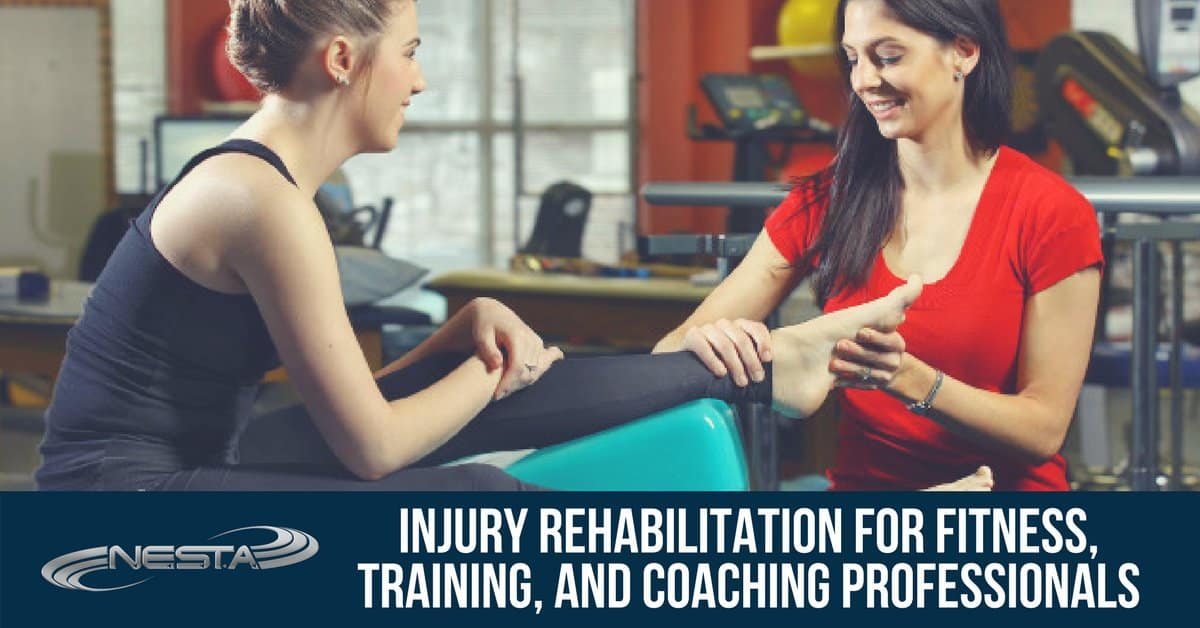
The goal of the physical rehabilitation and injury rehabilitation is to safely return your client to functional activity. As a fitness professional, you can play a role in achieving that goal. A successful exercise rehabilitation program should incorporate an “active” approach, as opposed to merely passive therapies.
Control Swelling
- P.R.I.C.E. (Price, Rest, Ice, Compression, Elevation)
- Modalities
- Medication
- Massage techniques can be utilized to decrease swelling and increase circulation.
- Improvement in the form of decreased swelling can be objectively quantified by using a measuring tape and documenting the results in centimeters.
- Recurrent swelling is a warning sign that something is wrong.
Control Pain
- P.R.I.C.E.
- Modalities
- Medication
- Psychological response
Maintain or Improve Range of Motion
Decreased ROM may be caused by muscle (tendon, ligament, capsule) contraction or swelling. Swelling is the body’s natural way of immobilizing an injured area, thus protecting it.
ROM will increase as swelling decreases.
Begin each session with general movements followed by specific stretching.
The range of motion is measured with a device called a goniometer.
Restore or Improve Muscular Strength, Endurance, and Power
Muscle weakness can be the cause of injury. In such cases, the goal is to increase strength, not merely restore it to pre-injury levels.
The strengthening aspect of a successful rehabilitation program should take a total body approach, and not solely focus on the injured area. This helps to maintain other areas of function.
Core stabilization strength training should be the foundation of all rehabilitation levels.
Programs should progress in intensity from low level to high level.
(For example: isometrics > progressive resistive exercise > Isokinetics > plyometrics)
Progressive Resistive Exercise
The progressive resistive exercise phase should focus on:
1.Functional Activity: Open Chain vs. Closed Kinetic Chain Exercises
Functional activity refers to those exercises that more accurately mimic real-world movements. While a rehabilitation program might initially employ open chain exercises, the goal is to progress to functional, closed chain exercises.
An “open chain” exists when the foot or hand is not in contact with the ground or some other surface, and only one muscle at a time is contracting. The seated leg extension machine is an example of an open chain exercise. It is not a “functional” activity.
In a “closed chain” exercise, the foot or hand is weight-bearing, and more than one muscle must be used to complete the movement. A single leg squat is a good example. It is functional and sport specific, and is the reason closed kinetic chain exercises have become so popular.
2. Sport Specific Training
Sport Specific Training refers to those rehabilitation exercises that reproduce the specific elements of the sport. Some sports require jumping, sprinting, long distance running or throwing. You can be creative and invent an exercise that reproduces the movement of the sport.
3. Core Stabilization Training
Core stabilization and conditioning training s another important component of a rehabilitation program. The core is where the center of gravity is located and where all movement begins. It is composed of 29 muscles in the low back, hip, abdomen, and pelvis. Core training will help improve: posture, muscular balance, functional movements, kinetic chain, and neuromuscular efficiency.
A weak core leads to inefficient movements of the arms and legs, which can lead to poor technique and injuries. Training should be gradual, safe, challenging, stress multiple planes and use a variety of resistance equipment.
Re-Establishing Proprioception, Kinesthesia, and Balance
PROPRIOCEPTION is defined as knowing where the body part is in space.
KINESTHESIA is defined as knowing when a body part has changed position.
BALANCE is defined as the integration of proprioception, kinesthesia, and muscular strength.
If injury results in decreased or discontinued use of the affected body part, the brain and nerves essentially “forget” how to fully connect to the injured body part.
Decreased proprioception, kinesthesia, and balance affect the body’s ability to correct improper positioning of an injured joint or body part. This inability can lead to re-injury.
Therefore, injury rehabilitation exercises must incorporate proprioception and kinesthesia to help the brain reconnect to the injured body part, take control of a specific movement, and improve balance.
Exercises that promote proprioception, kinesthesia, and balance include the Swiss ball, foam roller, Dynadisc, BOSU, and single leg squat progressions. These exercises help produce coordinated movements.
Cardiorespiratory Fitness
Cardiorespiratory fitness promotes healing by increasing heart rate and circulation – “in with the good, out with the bad”.
During and post injury rehabilitation, the injured client needs to maintain existing cardiorespiratory fitness level as much as possible and regain any lost cardiorespiratory fitness.
The level and extent of cardiorespiratory training are dependent upon the requirements of each sport.
Examples of cardiorespiratory training include stationary biking, upper body ergometer (UBE), swimming, treadmill, and elliptical trainers for low impact exercise.
Education
Without a thorough understanding of the technique and body mechanics associated with a particular sports movement, the athlete is more apt to repeat the improper body movement that led to the injury. Therefore, a successful injury rehabilitation program should include an educational component to train the injured person in ergonomics and proper technique for activities like throwing a baseball, serving a tennis ball, running, as well as routine daily activities like lifting items at work, or merely sitting at a computer.
As a fitness professional, you can provide a truly valuable and lasting benefit by continuing to educate and remind your clients of the benefit of proper body mechanics and ergonomics in all forms of activity.
Psychological Aspects of Injury Rehabilitation
Your client must want to get better. A negative or resistant patient is likely to heal slower and put far less effort into rehabilitation.
They must be mentally confident before returning to activity or competition.
Functional Progressions and Testing for Return to Activity
Functional progressions are a series of gradual, progressive activities designed to assist the patient with returning to a specific sport. They simultaneously prepare the athlete for return to activity, while allowing the therapist to gauge readiness to return to activity.
Functional tests are used to assess one’s ability to perform sport-specific skills.
These tests improve strength, proprioception, and confidence.
Functional progressions and testing should be performed with the athlete untapped or braced because it can give a false sense of the patient’s true level of function.
Athletes often ask, “When can I start playing again?”
The answer: “When you can pass the sport specific functional tests.”
Examples of a sport specific functional tests include running a figure 8 pattern, plant and pivot movements, jumps, backpedaling, high kicks, etc.
As a fitness and injury specialist, you can help assess the athlete’s ability and function, but the athlete knows their pain level and personal ability best.
Two additional guidelines can be employed to help the athlete decide if they are able to return to activity.
- 1-10 pain scale – pain should be a “4” or lower for a general return to activity. For important competitions/events, pain levels of 5-6 might be permissible. But rest and continued treatment should follow immediately after competition until pain levels return to 3-4. If the pain is reported at a level of 7 or higher, the likelihood of making the injury worse greatly increases.
- 80% function – the athlete needs to be performing at a minimum of 80% of their normal ability/function. Training at less than 80% may create a compensation injury in another area, or make the existing injury worse.