

 The Evolution of Nutrition Standards
Health insurance in many industrial nations today is really another way of saying prepaid medical expenses. Paying our monthly fees to insurance companies does not promise health; it just ensures that if we get sick, we won’t have to pay in full for our treatment.
We spend an exorbitant amount of money on medications and operations while virtually nothing is spent on prevention, education, and holistic health. The medical experts are basically saying, “Live as you’d like and we’ll deal with things later, when you’re not well”. What would it take to coach clients in a world where we value good health as essential to people being happy? Our approach is prescriptive and reactive; it’s less about preventing and informing.
Meanwhile, many Americans submerged in the healthcare system report a high number of medical errors, including getting the wrong medication or dosage, incorrect test results, a mistake in treatment, or late notification about abnormal test results. It is worse in other locations, to be sure.
If we pause to consider what has led us to the point we are at, we only need to look at how food is regulated. The USA is a great example of how the evolution of policy has directly impacted the nutritional intake of millions. Access to abundant food options has resulted in a host of problems that are related to the American food supply chain.
If you were shopping in a store that had high-priced and low-quality products along with poor customer service, chances are you would not go back to that store. But this is where we are today and our current situation is not one that happened overnight. Exactly how did we get here? Let’s look at some history for context.
The USDA: A History
Good nutrition is straightforward and simple, but in America pressure from the food industry makes it almost impossible for any public official to state the plain truth. Public nutrition policy is often dictated by the political process, which is now heavily dictated by a corporate agenda to maximize profits. The primary agency responsible for American food policy is the U.S. Department of Agriculture, which was created in 1862 as a regulatory agency to ensure an adequate and safe food supply for the American public. The agency also took on the role of providing dietary advice to the public. From the start, the government faced conflict. How can you protect public health on one hand and protect the interests of the food industry on the other? This opposition has led to decades of confusing and economically charged dietary advice (and maybe a little less politically charged).
The food industry’s greatest allies are part of Congress. It’s the job of these politicians to protect the interests of their states, which includes not only the citizens but also the corporations and industries that live there. So, a senator from Texas will support the cattle industry. A senator from Wisconsin is going to fight for dairy by not allowing any wording into government guidelines that will negatively affect the dairy industry. Politicians, together with skilled, well-paid lobbyists, control legislation and nutritional information put out by the government. In 1977 when senators from meat-producing states such as Texas, Nebraska and Kansas saw the new dietary guidelines, they worked quickly—with the help of lobbyists for the National Cattleman’s Association, among others—to amend the national dietary recommendations, removing any mention of decreasing the amount of meat in one’s diet for optimal health.
In the USA, The USDA, politicians, and corporations continue to shape the public’s awareness about what to eat. In 1991, the USDA and the Department of Health and Human Services created the first-ever Food Guide Pyramid to provide accurate guidelines about what to eat for optimal nutrition.
Immediately, the meat and dairy industries blocked publication because they claimed it stigmatized their products. Marion Nestle, professor and former chair of the Department of Nutrition at New York University, chronicled the saga in her pioneering book, Food Politics: How the Food Industry Influences Nutrition and Health. The meat and dairy industries were upset because the Food Guide Pyramid placed their products in a category labeled “eat less.” The USDA then withdrew the guide. It took more than a year to create a pyramid that was acceptable to the two industries. And that, my friends, is how our “politically correct” Food Guide Pyramid was created.
If we are being completely honest, the USDA Food Guide changes in the early ’90s seemed to also have political influences more so than nutritional science. It encouraged people to eat a lot of everything and this advice certainly helps the food industry and some of the politicians protecting their financial interests.
In 2001, the Physicians Committee for Responsible Medicine (PCRM) won a lawsuit related to the USDA’s ties to the food industry. PCRM objected to the over-promotion of meat and dairy products by the government because of the prevalence of diet-related diseases such as heart disease, diabetes, and hypertension. PCRM showed that most of the committee that reviews and updates the federal dietary guidelines had strong financial ties to the meat, dairy, or egg industries. The verdict found that the USDA had violated federal law by withholding documents that revealed a strong bias by the committee. PCRM’s victory was significant to the USDA, as governments do not typically rule against themselves.
2005 – an update to the guidelines
Four years after the PCRM verdict, the Dietary Guidelines Advisory Committee reviewed and updated the dietary guidelines again. This time, they had the task of responding to recent statistics showing skyrocketing rates of obesity across the nation. The USDA and HHS released the Dietary Guidelines report in January 2005, described by its authors as “the most health-oriented ever.”
The report recommended that Americans eat more vegetables and whole-grain products, cut down on certain fats, such as butter, margarine, and lard, and consume less sugar. The report strongly recommended that people “engage in regular physical activity and reduce sedentary activities to promote health, psychological well-being, and healthy body weight.” In other words: Get off your couch, America, and start exercising.
But this approach did not work for all. Besides, the guidelines didn’t speak a language easily understood by the people who most needed the advice. Imagine if the guidelines said, “Stop eating cookies, processed peanut butter, and ice cream; reconsider fast food intake and learn more about fats”. It’s something a health, wellness or fitness professional can embrace but it does not go far beyond that.
Another shortcoming of the guidelines was the continued recommendation of meat and beans and oils. But there were still some problems. For instance, the vegetable section is about the same size as the milk section. This led some to wonder – should the consumption of milk and vegetables be the same?
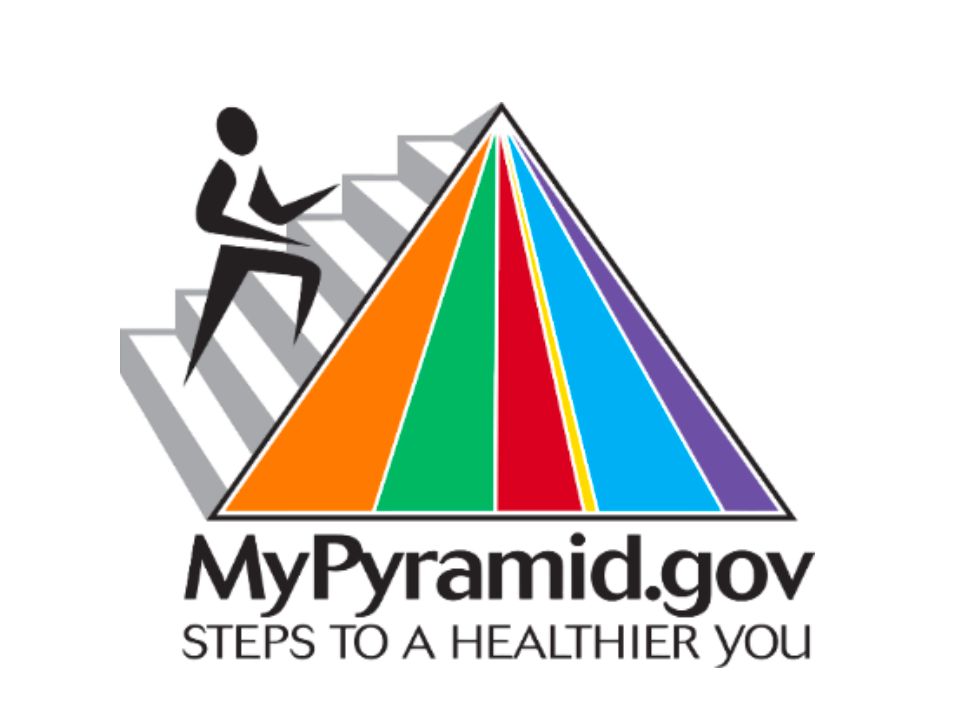
One big leap involves addressing different needs for more inclusive design, as we know that no one diet is right for everyone. MyPyramid recognized this fact by having 12 different pyramids, depending on the individual’s gender, age, and activity level. To get specific instructions on the appropriate amounts of food, you had to visit the MyPyramid website (fewer people had access at the time). And what about a pyramid for vegetarians or those on a vegan diet?
MyPyramid also promoted the idea that we can exercise every day and was constructed for people who exercise 30 to 60 minutes a day. The unfortunate reality is that we now know a plan created for people who do not exercise at all since that is what most Americans are doing.
Critics claim that one of the most influential and interesting outcomes of these food guides is the government’s lackluster follow through with the policies it recommends. The intended purpose of these guidelines is to provide the public with information on what to eat. How is the government persuading consumers and food producers to implement their advice? Has it restricted the amount of salt or sugar permitted in certain foods or reduced advertising of junk foods to young children? Does it support farmers who grow predominantly vegetables and whole grains? The government does not financially support its advice to eat more vegetables and whole grains, eat less sugar, unhealthy fats, and soda.
The sad truth is that most Americans eat less than one piece of fruit per day. Also, less-than-ideal: the three most popular vegetables are iceberg lettuce, tomatoes (either canned or in the form of ketchup), and potatoes. Clearly, America’s actual food consumption is nowhere near what the USDA is recommending.
Part of the problem might come from the fact that the federal government, with an annual budget of nearly $4 trillion, spends no money promoting the food guides. The government simply develops the guidelines and leaves the advertising and education in the hands of the corporations who make money off product sales. Why would a wealthy country in the middle of an obesity epidemic not allocate resources to help its citizens with diet and nutrition?
Some might think it’s strange that the government has no budget for advertising their health advice yet still finds a way to contribute resources to other food campaigns. Perhaps you’ve seen the slogans: “Got Milk?” “Beef. It’s What’s for Dinner” and “Pork. The Other White Meat.” These campaigns, aimed at increasing Americans’ consumption of dairy, beef, and pork products, are part of the federal government’s commodity promotion programs called “checkoff” programs. Checkoff programs suggest that what the government tells us to eat is contradictory to where it focuses its time and money.
Chose My Plate
In response to the updated 2010 Dietary Guidelines, the USDA announced its replacement of MyPyramid with MyPlate. The icon was revealed by Agriculture Secretary Tom Vilsack and then First Lady Michelle Obama. The goal of the MyPlate icon is to simplify nutritional information so it’s more useful to the average family. The First Lady says, “When it comes to eating, what’s more, useful than a plate?” And she’s right. It makes you wonder why it took so long to present such a basic, recognizable tool.
Unlike the pyramids of the past which attempted to convey how much you should eat based on the colors and relative sizes of sections on the pyramid, MyPlate focuses on the portion sizes at each meal through simple divisions of a plate. It makes it visually obvious that half of your plate should be fruits and vegetables. The MyPlate icon also features selected messages, like “avoid oversized portions” and “enjoy your food, but eat less.” However, as with the pyramid, you must visit the MyPlate website for specific instructions on what to eat.
MyPlate is a huge step toward instilling healthy changes in Americans, but it still has many shortcomings. Critics point to dairy as the essential part of a meal plan, when the evidence showing the risks of dairy consumption outweighing the benefits continues to mount. But how accurate is the research, if our research presented from an ACSM Position Statement found that Protein – specifically that from milk-based products – was superior for intake in certain training environments (such as recovery)? If we know refined grains are linked to chronic diseases like obesity, and we know that Americans consume too many refined grains, shouldn’t the recommendation be for all grains to be whole?

Food Giants: Corporate Food Interests
In the USA, the government largely leaves the advertising of the USDA food guidelines in the hands of the food corporations. These corporations are free to communicate with the public about the nature of their products, often using the Food Guide Pyramid as a vehicle for their own agendas. Sometimes they appear to be deceptive. When the new pyramid was released in 2005, General Mills announced that about 100 million boxes of its Big G cereal brands would carry MyPyramid on them, citing that the cereal box is one of the best places for consumers to learn how to understand food labels and how they factor into our busy lifestyles. The company also announced that they would reformulate their products to include whole grains, which was in line with the recommendation of the new pyramid to eat more whole grains, thereby suggesting that many of their cereals, including Lucky Charms, Trix and Golden Grahams, are healthy. We all know that is beyond a bit deceptive!
The supermarket shelf is a free-for-all in which companies can make many claims about their products, and public health authorities rarely interfere.
Food corporations are big business. In 2019, PepsiCo had more than $67 billion in sales; Sara Lee, once sold to Tyson after doing a dance with Hostess and a few others… is now owned by an equity firm in New York – would seem to have a vested interest in not following healthy food guidelines. Kellogg $13.6 billion in sales. Largely from processed cereals, coming from wheat fields that have been stripped of their nutrient-rich soils.
The fast-food and restaurant industries also generate billions in annual sales. McDonald’s raked in over $2.08 billion in 2019 after a peak of $28 billion in 2013. All these corporations put substantial amounts of cash back into advertising. Recently, it seems there is a shift, with many food corporations trying to create a healthy image and pass off its products as being good for our health, but no one regulates the word “health.” No standards exist for the phrase “good for your health.” Essentially, most food corporations are using the dollars of their profits to suggest their products are healthy. For most of them, it is as saying that one of the ingredients is derived from whole grain.
The food industry spent $51 million on specific food and agriculture lobbying. This figure does not include the additional $13.2 million spent by Altria Group, which was the parent company of Kraft Foods at that time. These big bucks pay off, giving these corporations major unfair advantages when it comes to food policy and regulations.
We have to acknowledge the progress made in January 2006, when the FDA required all packaged foods to list trans-fat content on their Nutrition Facts labels. Trans-fat is a compound created by chemically adding hydrogen to liquid vegetable oils. Food manufacturers have used trans-fats for years to enhance flavor, extend the shelf life of packaged foods, and give a more solid texture to baked and fried foods. In the early 1990s, studies began to link trans-fats and heart disease. Research now shows that eating trans-fats increases cholesterol and risks of developing heart disease, diabetes, and cancer. Despite these facts, food corporations have dragged their feet to eliminate trans-fats from their products. Most corporations continued to use this substance until the law required them to list it as an ingredient. Companies had to choose between listing an unhealthy ingredient on their products and risking decreased sales or finding an alternative ingredient. Now many products with bright lettering displaying “No Trans-fats” line shelves.
Corn, in its natural state, is not a bad food to consume. As a grain, we know it has been over-planted, over-processed, and often over consumed. High fructose corn syrup—an artificial ingredient found in most sodas and junk foods—is an inexpensive use of corn. Low corn prices have led to artificially low meat prices because corn has become the number one feed for cattle—a major shift from a traditional grazing diet. The overproduction of soybeans and corn provides an inexpensive way to add flavor to packaged junk food, fast food, corn-fed beef and pork, and soft drinks. For consumers, these less nutritious foods are cheaper and somewhat tempting to people living on a budget. These subsidies contribute to the obesity epidemic by making it cheaper to produce and purchase unhealthy, packaged foods.
As a result of the subsidies, growing fruits, vegetables, and other grains is less lucrative for farmers. Less than ten percent of USDA subsidies are spent on fruits and vegetables. We should be asking why vegetables, fruits, and whole grains aren’t heavily subsidized so they can be cheaper and more accessible to everyone. Obviously, this change in policy would go a long way in helping Americans follow their own government’s nutritional guidelines. This disparity in government funding points out an awkward realization about the USDA: it urges people to eat food incongruent with what it pays farmers to grow. But the food guidelines being a bungled mess are only half the equation.
We use the most current, relevant, important and proven nutritional stands as part of our courses including, the Holistic Nutrition Coach Certification, Fitness Nutrition Coach Certification and Lifestyle and Weight Management Specialist Certification.