

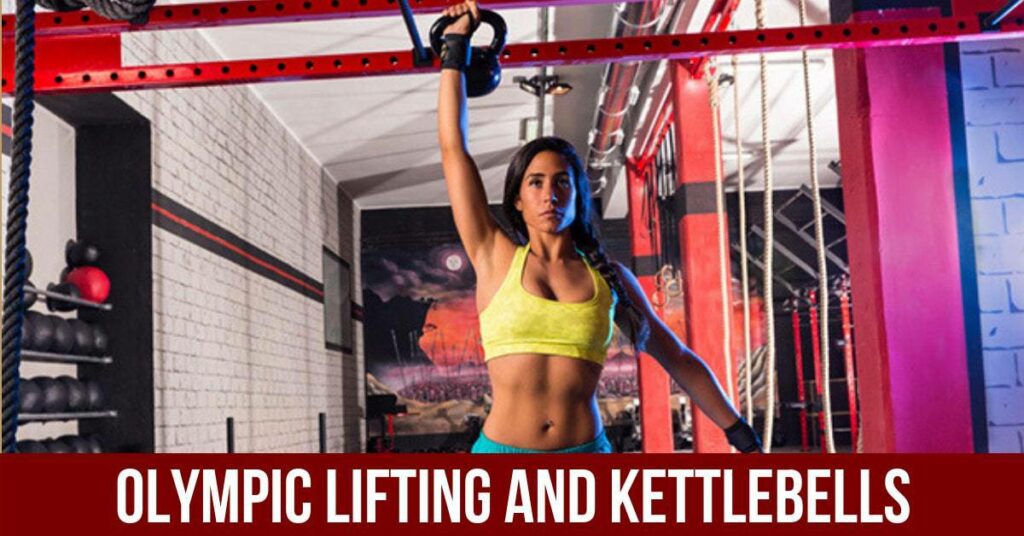

Olympic Lifting and Kettlebells
I love weightlifting. I incorporate many different clean and clean + overhead variations with my more advanced athletes. Athletes who have been training with me for a while have developed a solid foundation of strength and coordination.
I have, unfortunately, seen cleans in high school weight rooms that resembled a super wide jumping jack combined with a backbend. What the hell is this craziness? Here’s what I like to do:
- Develop a solid foundation of strength through our introductory and intermediate style exercises. Lots of sleds, calisthenics, Kettlebells, Lunges, Back extensions and band work. Then we progress to basic barbell exercises to further strengthen the body, especially the legs and back.
- Introduce the front squat. Build up that rack position and teach athletes how to get strong from what tends to be very uncomfortable at first. After the front squat starts looking solid, we introduce very simple clean variations, usually the hang clean first.
- At the college level, many wrestlers and football players have wrist, shoulder and finger injuries. Sometimes, these clean variations become too tough on their joints, so you must have knowledge of regressions of the Olympic lifts. Can’t do a clean because of an injury? No problem, we’ll do a clean pull, sometimes a muscle clean.
Olympic Lifts
I recall planning my first training session with the top 10 ranked D1 Wrestling Team. I planned on deadlifts that day and just attacking the weight room. More than 50% of these guys could not pull 185 without hunching over. Very few could hip hinge and sit back.
If an athlete can’t deadlift, he likely cannot perform a clean from any position. Strong is strong. Don’t ever underestimate just how unprepared and weak athletes are. Even if they LOOK strong, there is a difference in truly being strong.
These college wrestlers went on 3-4 weeks of training like my middle school athletes.
- Sleds
- Carries of all types (Kegs, Dumbbells, Kettlebells)
- High Volume Band face pulls, band triceps, band pull-aparts
- Unilateral Work for lower body: Split Squats, Lunges & Step Ups
- Dumbbell Benching of all angles
- Calisthenics for warm-ups and working sets
- Dumbbell Quick Lifts (Snatch, Clean & Press)
- Dumbbell Rows
- Back Extensions
Once the foundation was built, I was able to progress these guys into basic barbell work, mostly powerlifting style lifts. From there, we began incorporating power and hang cleans. It takes time and advanced athletes are often times NOT advanced lifters.
Kettlebells are derivatives of the Olympic lifts and are much easier to learn. If kettlebells are not an option, dumbbells can be used for the snatch, clean and jerk or clean and press. I’ve known many Coaches who prefer KBs and DBs over Olympic Lifting. It all depends on your philosophy and your own level of skill in Olympic Lifts.
When I began immersing myself in weightlifting, I learned from Travis Mash. The more I learned from Travis, the more I incorporated clean variations into our training. I became a better student which led to me being a better teacher and coach.
It is easier to teach basic barbell powerlifting style movements than weightlifting. However, if you can properly progress the weightlifting into workouts where you’re not spending 45 minutes using a PVC pipe when you need to get stronger, you CAN make it happen.
- Use the barbell as a warm-up for your athletes. Take them through an empty bar complex coupled with some light jumps, light bands, mobility and core/trunk/ab work.
- Do 5 reps of a few exercises for every warm up. Each week, the warm-up can progress and you can slowly introduce some working sets.
- After the Olympic lifts, hit some basic strength work to move more weight and develop that brute type strength.
First 15 minutes of a training session:
- Movement Prep
- Sled Work
- Barbell Complex x 5 reps each:
- Hang Clean
- Front Squat
- High Pull + Hang Snatch
- Overhead Squat
- Back Squat
After the first complex, add some weight. Then, hit 3-4 rounds of the complex and go from 5 reps each exercise down to 2 or 3 reps of each. Once these lifts look good, incorporate some heavy work into a training cycle on the clean or hang snatch. If your athletes are trained up properly, you can perform full cleans with them.
You’ll be amazed how athletes can move better than you think when you challenge them, teach them properly and give them a chance to make a few mistakes and correct them each set.
I love coupling or Olympic Lifts with jumps. The emphasis on speed and power helps keep the athlete mentally focused on being aggressive and moving the bar and their body with speed.
Kettlebell Training
Kettlebells were a rude awakening for me when I first began using them. I remember purchasing them from an instructor in North NJ, before there were companies all around selling Kettlebells. At the time, there was but 1 company and they were expensive!!!
I drove up to North NJ on a freezing cold winter night with $550. I remember being nervous that I was investing over half a grand and 2 pairs of Kettlebells. I was so hungry to learn and grow my business, I was ready to bleed for anything.
I paid the instructor the $550 and he had them sitting on his front porch. I carried a pair of 53 and 70 lb bells and they felt heavy as all heck, way heavier than dumbbells of the same size! I had no problems throwing around 70 lb dumbbells while training but using 70 lb kettlebells seemed like a goal that would take a while to reach. I spent months working with the 53 lb kettlebells before progressing to the 70’s!
I remember how heavy the 53s felt for me and I immediately questioned if I should have purchased the 70s! I was nervous about the money and nervous about the journey of being a Strength Coach. The only option I gave myself was to get better, to learn and to move forward!
I love the simplicity and versatility of Kettlebells. Still, I see many basics and fundamentals getting butchered by those who do not learn to properly use Kettlebells. Learning how to hip hinge, how to slide your hand through the bell to avoid beating up your wrists and forearms – these skills must be practiced, not butchered.
The kettlebells will certainly challenge you and hit your body in ways you never experienced before if you implement them beyond the KB swing.
Here’s a list of the common KB exercises I implement in my own training and with the athletes I work with:
- Farmer Walks
- Overhead Carry
- Rack Walk
- Mixed Position Carry (Carry each KB in a different position)
- Offset Carry (same position, 2 different weights)
- 1 Arm or Double Clean & Press
- 1 Arm or Double Bent Over Row
- Renegade Row
- Turkish Get Up
- Get Up Sit Up (Legs Locked Down, Holding 1 KB, 5 second eccentric)
- Floor Press (Press See Saw Style or same time)
- Flat & Incline KB Benching
- Windmill
- 2 Hand Swing, 1 Arm Swing, Double KB Swings
- Squats (Goblet, 1 Arm Rack, Double Rack)
- Lunges (All Variations & All Positions for Loading)
I will even use lighter KBs for Hammer Curls, Shoulder Raises and Lying Triceps XTs. Some other unique exercises can be done off a Glute Ham Bench:
- Isometric Sit Up Hold while doing a 1 Arm KB press (Body Parallel to Floor)
- Sit Up + Overhead Press with 1 or 2 KBs
- Back Extension + Double or Single Arm KB Row
The Kettlebells have a different feel than dumbbells. I don’t prefer one tool over the other. I don’t get caught up in “this is the best tool”. They ALL work when you train the right way.
I also like to implement lighter KB work during a reload week and during warm-ups with athletes. Here’s a sample warm up I’ll do in the weight room after movement prep. I blend the warm up with DBs, bands, calisthenics, abs and some mobility. Here are a few samples:
2 Rounds Circuit:
- 1 Arm KB Cross Body Clean x 5 / 5 (KB goes diagonally across the body)
- 1 Arm KB Row x 5 / 5
- 1 Arm KB Shrug x 5 / 5
- 1 Arm KB Rack Squat x 5 / 5
- KB Goblet Reverse Lunge x 5 / 5
- KB Goblet Pause Squat x 5 (3-sec pause in bottom)
- DB Bench x 20 (10 elbows out, 10 palms in)
- Band Face Pull or Pull Apart x 20
- Any Leg Raise Ab Variation x 10
- Any Plank Variation x 60 seconds
- Back Extensions x 20
- Band Triceps x 20
- Hip Circle Walks x 100 ft (forwards, backward, lateral)
- Bulgarian Split Squat x 10 / 10
- Couch Stretch x 30-60 sec each leg
Looks like a lot of work and it is a lot of work. But, the athletes I train are fit, they are beyond just capable of moving big weight. They need durability and endurance, both physically and mentally.
Sometimes I go with less variety and just a few exercises, 2-4 rounds of high reps, like this style:
3 Rounds: Upper Body Day Warm Up
- DB Inch (Various Positions) x 15-20 reps
- Chest Supported Rear Delts x 15
- Band Triceps x 15
- Band Face Pull + External Rotation x 15
3 Rounds Lower Body Day Warm Up:
- Bulgarian Split Squat x 10 / 10
- Alternate Forward, Reverse, Lateral Lunges x 5 each direction
- Hip Circle Walks
- Sleds x 100 ft
- Back Extensions x 10-15 reps
- Recline Row x 10
- Various Ab Exercises x 10
During warm-ups, I am assessing energy levels, mobility, and overall attitude. If the guys seem sluggish, I might sneak in some sprints up short stairs or some quick sprint acceleration races.
I might add a quick jump circuit to hype them up, something like this is simple yet very effective:
3 Rounds of prescribed Reps Non-Stop:
- Hurdle or Bench Jumps x 4
- Clapping Push Ups x 4
- Mixed Grip Explosive Pull Ups x 4
If athletes are making painful faces in the bottom of bodyweight squats I sneak in hip mobility and light pause squats with a KB.
If upper body seems to be cranky I incorporate some soft tissue smashing of the pecs, lats and upper back. Some dead hangs from rings or a pull-up bar. Maybe some partner med ball drops where the man on the floor blasts the med ball back up. We’ll go back and forth for 5, 4, 3, 2, 1 reps.
The power work hypes them up and creates a mind-body connection to prep them for a great training session. This is auto-regulation, where you assess the athletes during the warm-up and the training session and you adjust the training day accordingly.
Here’s a sample power complex I did with athletes after they did a warmup, yet I wanted them to demonstrate some excitement before it was time for them to train:
- 1A) Hurdle Jumps 5 x 4
- 1B) Med Ball Rotation Wall Throws 5 x 5 / 5
I had the 24” hurdles out which were used by our middle school athletes and most of our high school athletes used our adjustable hurdles that are set at 30” or slightly higher. Once they got going with jumps and throws, you can see that they were more excited to train and mentally, they got fired up. Moving the body, especially through jumps and movement is crucial for building athleticism.
Another example…
On the same day, I had a larger group of athletes come in. After a long winter, I knew they could use some fresh air. We partnered up and each group did farmer walks with a pair of light kettlebells.
We would switch every 75 ft or so, and we walked the Kettlebells to a playground park right near my gym. I brought a Rugby ball with me. Once at the park I took them through a little bit of work:
2 Rounds of:
- 1 Arm KB Clean & Press x 5 / 5
- Bodyweight Pull (Pull Up or Recline Row) x 90%
- Bulgarian Split Squat x 10 / 10 off a picnic table
Simple, but we got some work done in addition to the farmer walks. Then, we played a game of Ultimate Football 5 vs 5. The athletes are sprinting, decelerating, jumping and overall being ATHLETES.
After warming up the college athletes and prepping for back squats, I incorporated some low rep jump training to fire up the nervous system, here is a sample of jump work after a thorough warm-up:
- Barbell Squat Jump (empty bar or very light loading) 2 x 10 reps (The first 5 Jump reps are very short bend of the knees + a very rapid squat jump. The Next 5 reps are full range squat jumps.) This builds power from multiple angles vs only full range squat jumps.
2A) Lunge Jumps 4 x 4 (2 lunge jumps each leg)
2B) Explosive Recline Row 4 x 8 (Pull Chest aggressively to rings)
2C) Overhead MB Slam 4 x 4
You can learn more about creating fitness and training routines like these above in many of our certification courses.
Click here, to check them all out and see which you would be interested in!