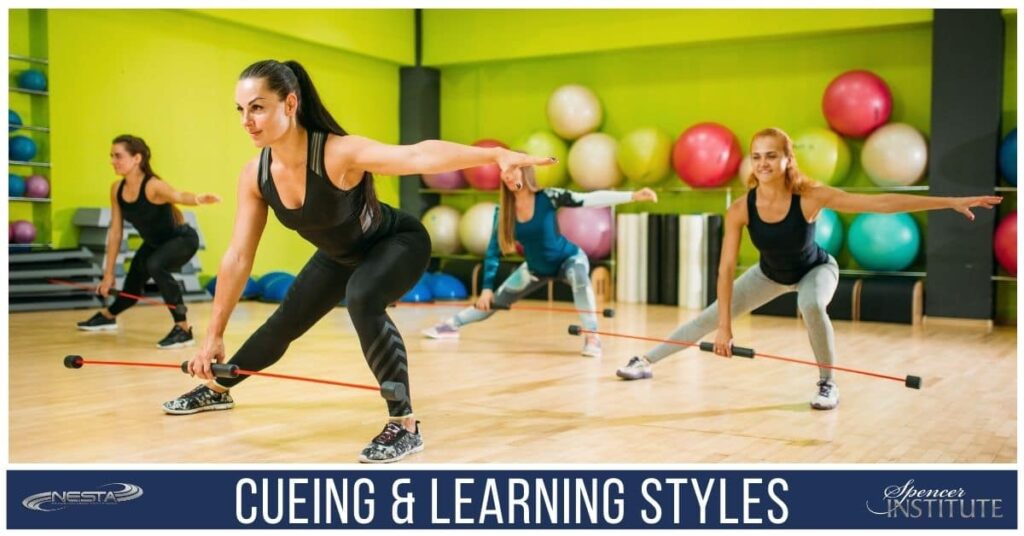
Cueing & Learning Styles

There are three basic learning styles: visual, auditory, and kinesthetic. People can be a mix of all three, but many have a stronger preference for one. These hold true for school, the workplace, and group fitness classes. Understanding the way people learn is hugely important because if you don’t teach all three styles, you could frustrate and lose 1/3 (or more) of your class.
Visual Learners
Learning Through Seeing. Most people fall into this category. Visual learners learn best by seeing the information being taught. Seeing would include activities such as reading text and looking at pictures, flow charts, or diagrams. Visual learners also process information while observing demonstrations; for example, when watching a trainer perform a movement several times. In group exercise classes, these are the actual physically demonstrated things that instructors do to show a movement, form, or technique.
Raising the arm or pointing to the foot are examples of visual cueing. While this method is physical in nature, it does not replace the use of the spoken word. The instructor is still required to explain what is expected of the participant while the visual cue is being given. Words used during the visual cue must be spoken in the appropriate order.
For example, if the desired result is to have the participants walk towards the rear left corner of the room, the instructor must first begin with the left walk facing the front of the room, then angle the left shoulder towards the left rear corner of the room, then move the participants in that direction. It is advisable that the instructor cues the ‘move’ first, and then follows through with the directional.
Auditory Learners
Learning Through Hearing. Auditory learners prefer to learn by hearing instructions, listening to lectures, and taking notes. In group exercise classes, these are the words that the instructor speaks to the participants. The actual verbal explanation of how to perform a move, what you expect the participants to do, and how to get there are conveyed in the verbal cueing. Verbal learners are also good at associating music with movement.
Kinesthetic Learners
Learning Through Doing. Kinesthetic learners prefer movement and hands-on activities. They like to use the senses of touch, smell, and taste in the learning experience. In group exercise, it’s also called tactile or physical cueing and is used to teach proper movement patterns, as it trains their kinesthetic awareness. This is more often used in personal training, but a situation may arise where you physically need to assist a member through a motion to get the desired pattern or position.
Balancing All Learning Types
Recognizing that not all students learn the same way requires that an instructor use a variety of cueing techniques to convey a single concept or bit of instruction for all participants to understand and follow along successfully. Much of what you’ll do depends on the types of classes you teach.
A yoga instructor might never touch the mat or do a single demo, but instead, verbally cues each movement, walking around using hands-on corrections (a blend of auditory and kinesthetic). A hip-hop instructor might perform every single step, emphasizing movements, visually showing each step. Find what’s appropriate for the classes you teach and know that balancing all three types in each class just takes practice and discipline.
Getting Started
Learn how to teach an effective warm-up, cardiorespiratory segment (low-high), sculpting, bodyweight exercises, dynamic flexibility, metabolic HIIT bursts, cool-down and stretch with our Group Exercise Instructor.
Check out what it takes to start a career in personal fitness training. This is your most affordable and fastest way to become a highly qualified personal trainer.
Is your recertification coming up? Learn more about earning your CEU credits. You can find the full list of CEU courses here.
If you are ready to start your online personal training or coaching business, don’t forget to learn more about our online coaching course. You will also really enjoy this very comprehensive training course called Online Expert Empire.
There is always something exciting about earning a new training or coaching certification and applying that new knowledge of how you train your clients. This also helps you hit the reset button.
NESTA and Spencer Institute coaching programs are open to anyone with a desire to learn and help others. There are no prerequisites.
That’s it for now.
Take action!
PS: Click here to see many helpful business/career resources